Dear darkening ground,
you've endured so patiently the walls we've built,
perhaps you'll give the cities one more hour
and grant the churches and cloisters two.
And those that labor - let their work
grip them another five hours, or seven,
before you become forest again, and water, and widening wilderness
in that hour of inconceivable terror
when you take back your name
from all things.
Just give me a little more time!
I want to love the things
as no one has thought to love them,
until they're worthy of you and real.
-Rainer Maria Rilke, from the Book of Hours: Love Poems to God, I 61
Sunday, June 8, 2014


Tuesday, July 30, 2013
A Blessing in the Dust
A poem-blessing for this transition time, passed on to me by someone (a graced encounter) who just left Elkhart, Indiana, who I met just two weeks before I leave there for seminary...
A Blessing in the Dust
You thought the blessing
would come
in the staying.
In casting your lot
with this place,
these people.
In learning the art
of remaining,
of abiding.
would come
in the staying.
In casting your lot
with this place,
these people.
In learning the art
of remaining,
of abiding.
And now you stand
on the threshold
again.
The home you had
hoped for,
had ached for,
is behind you—
not yours, after all.
on the threshold
again.
The home you had
hoped for,
had ached for,
is behind you—
not yours, after all.
The clarity comes
as small comfort,
perhaps,
but it comes:
illumination enough
for the next step.
as small comfort,
perhaps,
but it comes:
illumination enough
for the next step.
As you go,
may you feel
the full weight
of your gifts
gathered up
in your two hands,
the complete measure
of their grace
in your heart that knows
there is a place
for them,
for the treasure
that you bear.
may you feel
the full weight
of your gifts
gathered up
in your two hands,
the complete measure
of their grace
in your heart that knows
there is a place
for them,
for the treasure
that you bear.
I promise you
there is a blessing
in the leaving,
in the dust shed
from your shoes
as you walk toward home—
not the one you left
but the one that waits ahead,
the one that already
reaches out for you
in welcome, in gladness
for the gifts
that none but you
could bring.
there is a blessing
in the leaving,
in the dust shed
from your shoes
as you walk toward home—
not the one you left
but the one that waits ahead,
the one that already
reaches out for you
in welcome, in gladness
for the gifts
that none but you
could bring.
-a poem by Jan Richardson
Saturday, June 15, 2013
Days 21-25, Camino de Santiago
Day 21. Los Arcos.
One of the TOUGHEST days on the Camino for me. Not just because it was raining buckets all day. Not just because the famous wine fountain of Irache with free wine for pilgrims was closed (below), and not because Rachel forgot our goat cheese at the Albergue (I promise that before I die, I will forget that ever happened). I just wasn't fully awake and focused mentally, and it was one of those days when the reasons why I am on this pilgrimage seemed empty. I missed family and friends and wished for "normal" life when I don't have to get up early to trudge through the mud for 6-7 hours, then wash, eat, sleep and repeat.


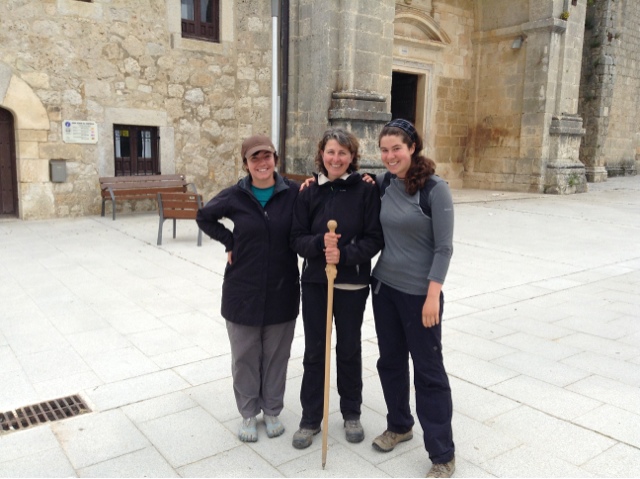

Day 22-23. Logrono and Ventosa.
Yesterday's doldrums were gone somehow when I awoke to rain on what would be our longest day yet - 30ish km, about 18 miles. Rachel and I sang a lot on the trail, which helped lift our mood and give us energy. And at a certain point, I stopped caring that my pants and feet were soaked. We met up with some pilgrim friends from Argentina, South Africa, and Orange County (isn't that a separate country?), and went out for tapas that evening in the beautiful city of Logrono, which was celebrating its patron saint. We went to bed at 9:30, just as the festividades were starting! The mural below says "El Camino de Santiago se hace por (E)Tapas," jeje.
Day 24. Santo Domingo de Calzada.
Today was a strange day. We walked about 7 hours and reached a mostly abandoned housing development at the top of a hill with an empty golf course and for sale signs everywhere. It was like something out of the surreal suburbs of Phoenix - pavement and tract housing and fake landscape. Tired, we looked for an Albergue listed in our guidebook called the Virgen de Guadalupe. We knocked and knocked and finally a man opened the door with a loud "SI?!" As soon as we stepped inside, Rachel and I both felt creeped out. No one else was there. The man said it would be 13 Euros each, twice what we usually paid for a place. We peeked into the dark kitchen and bedrooms and all the while, the bad feeling grew. I looked at Rachel and without even talking, we decided to get out of there. It was another 6 km until the next village, but we were glad we trusted our intuition!
Rachel even picked up dinner along the way (below). Just kidding, the church in the town we stayed in is famous for a legend involving a chicken.
Day 25. Belorado
Today was a wonderful time of serendipitously running into friends we had met along the way. One of these was Ann-Dominique. I told her she was the funniest, most genial French woman we had ever met. Ann spoke only French, but I felt an instant connection with her. She is hiking the Camino as a retreat to have some time to herself (context: she has 6 children to care for at home), to see who God brings her way each day, and to pray. One gets the feeling around Ann that she must be close to God because of the warmth of love and joy that radiates from her. She showed me much of the Mother's tenderness and light, and even though we probably talked for only 4 or 5 hours total, we were all in tears when we had to say goodbye.
Day 26-27. Ages-Burgos
Last days on the Camino! We ran into a mother and daughter who were not doing so well relationally when we first met them in the beginning of the trail - people say to be careful who you hike with - and I thought about them often as we hiked. They were committed to finishing, though, and the daughter said she wanted the Camino to be a way to reconcile with her mom, who she had a painful history with. Praying for a break through for them!
I left them feeling thankful for walking with Rachel. Though we saw the worst in each other at times, we also learned to depend on one another, communicate better, see the best in each other, and show love through small acts like washing the others' clothes, changing how we would normally do things, or letting the other person shower first.
I'm sure I will have more thoughts on finishing the Camino and what it meant, but for now I am glad to have made it, glad for a stronger friendship with my sister, and glad to be coming home in a few days!
Ours were the last shoes on the shelf at the Albergue today - the journey is over for now!
Monday, June 10, 2013
Days 16-20, El Camino de Santiago
Day 16-17. Roncesvalles to Larrasoana.
One of the most crowded stretches of the Camino so far; I would estimate about 200 people started with us in Roncesvalles. I think the number of pilgrims on the trail created a scarcity mindset, because this section felt rather competitive. Some pilgrims rise at 5 in the morning so that they can be the first to arrive and claim a bed at the next Albergue (Spanish hostels don't take reservations). We left at 6:30 or 7 and arrived at our destination around 2 or 3 pm with three of the five Italians we met that day. The Albergue only had a few bunks left (and it was the only place in town), but the Italians decided to wait for their friends to catch up before checking in, even though they had just met one another. In the end, they all got beds, but 30 minutes later we saw some other sad pilgrims get turned away.
Below is a picture of a table at the Albergue in Roncesvalles where pilgrims leave behind whatever they carried over the Pyrenees the day before and decided they didn't need. Cast-offs ranged from an electric razor to fancy shoes to a book on how to succeed in business. Rachel and I gladly picked up a National Geographic and a little shampoo, both of which felt like a luxury. Maybe we missed the point of lightening our packs, but the metaphor of carrying only what is essential in life did not escape us.


And here is Rachel running from some bull statues... We both were a little "bull-headed" later that day and got in our first fight of the trip, but after some alone time and apologies, we realized half of our troubles had stemmed from hunger. Five tapas later, things were back to normal.

Day 19. Puente la Reina. Today I walked for a few hours with a warm, talkative man named Alfonso who does the Camino de Santiago every decade, and is walking this time for his 70th birthday! He lives in Valencia but is Basco. Since we are walking through Navarra, Basque country, it was interesting to hear a little about the history and politics of the region from him. Alfonso's brief history of Spain went like this, "Guerra, guerra, guerra, y despues, Franco." War, war, war, and then, Franco. He understandably did not seem to want to talk about the nearly 40 year dictatorship, which he experienced until he was 33 years old, except to say it was a terrible time.

Day 20. Estella. 
Thursday, June 6, 2013
Days 11-15, Camino de Santiago
Days 11-12. Arrived at Conque, our final destination on the French side of the Camino! We stayed at a Benedictine monastery famous for housing the remains and relics of St. Foy (Santa Fe), a girl who was tortured to death by the Romans in the 4th century because she professed to be a Christian. Below is a monk explaining the ornately carved tympanum of the Last Judgement over the door to the church, where we later gathered with about 40 other pilgrims for evening prayer and singing (compline).

Day 13. St. Jean Pied de Port. This is our starting point for the Spain side of the Camino de Santiago; it is a fortified city in the lower Pyrenees on the French side of the border. It has been good to rest since Rachel has a sore throat and I'm having some arch problems because of my flat feet. Here she is in front of the scallop shell symbol, which pilgrims carry on their packs and is a sign of the Camino.

Day 14-15. Crossing over the mountains. Before leaving St. Jean, I received word that a young man died who I worked with last year at Community Roots Garden through a gang reduction program. He died after a fight from stab wounds. I hiked over the Pyrenees with heaviness, remembering Erin and carrying his family, friends and enemies in Oxnard with me. Praying for an end to violence like this, for those who carry heavy burdens every day, and that I may be a part of the things that make for peace.

Monday, June 3, 2013
Churches along the Way
I've been thinking about how Catholic Christianity in Europe (the little I have seen so far, at least) is so different from the forms of church I have grown up with. It feels very foreign, like another religion altogether. I can't seem to wrap my mind around it or identify with its practices and beliefs, though I have worked and worshipped with Catholic-based groups without feeling this great of dissonance in the past. When we stop along the Camino to visit towering gothic cathedrals and Romanesque churches, built as far back as the 10th and 11th centuries from beautifully carved stone, wood and stained glass, I feel as if I am in an art museum rather than a place of worship. I admire the holy relics, but in the back of my head, I think that the gold and jewels would have better served the poor. The people who come now are mostly tourists; even the water in the stone baptistries has dried up.

As we walk through these former hubs of religious and political life in Europe, I find myself remembering my Anabaptist ancestors, who were persecuted by the Church authorities a little further north of here during the 17th century, who gathered in mountain caves as their places of worship, and who secretly baptized followers of Jesus in the wild, muddy rivers that I still see flowing through these hills.
Friday, May 31, 2013
Days 6-10, Chemin de Saint Jacques
Day 6. Almost a blizzard! We walked with snow blowing against us all day. Here I am demonstrating our multipurpose gear in action (sheet scarf and sock gloves). Something about walking with my head down against the wind, just putting one foot in front of the other all day made me go into kind of a meditative state. Though at one point I realized my mantra with each step had become, hot cocoa, hot bath. Hot cocoa, hot bath. It's amazing what focus one can have with only basic necessities in mind (I realize I'm including hot cocoa in that category). And what joy one has when they are finally reached. 
Day 7. Transhumance Festival in Aubrac. We arrived in time to see this lively annual tradition on the Aubrac Plateau - the moving of the herds to higher pastures for summer grazing. Traditional village dancing, music, and food accompanied the successive groups of cows and herders that walked through town. Rachel and I tried some aligot, basically mashed potatoes with enough cheese mixed in to make them stringy, and almost bought donkey sausage because we thought the man who said, "it's like a horse with small ears" was describing venison.

Day 8. Dropped elevation below the snow level for a gorgeous walk today on a path spongy with wet fallen leaves and the sun coming through ash trees like shades of green stained glass.
Day 9. We have been passing through some of the most bucolic little villages these past few days. It strikes me that each one is constructed from and so resembles its landscape. Some towns are pinkish red from the sandstone below, used to build the houses and churches, others are built with granite stones, mossy and softened with age. Even the roof tiles change depending on the local resources; in this region all the houses have slate shingles. And in every rural town, the majority of the houses have a huge garden that takes up the whole space of what would have been their back or front yard. Here's a picture of a particularly large one below, replete with lettuces, sweet peas, potatoes, tomatoes, carrots, and strawberries.


PS. My mom said some of these pictures are getting cropped off (maybe because I'm using an iPhone?), so if you can't see them then sorry.
Saturday, May 25, 2013
Days1-5, Chemin de Saint-Jacques
Day 1. Le Puy en Velay; bright-eyed and bushy-tailed!
Started our journey with about 50 other pilgrims in a small town famous for its green lentils and lacemaking. At morning mass, we received a blessing and a special pilgrim passport to show at each hostel along the Way. An ornately dressed statue of a dark mother, or the "black virgin," presided at the front of the 11th century cathedral. I lit a candle in front of a statue of St. Jacques the pilgrim for our journey, and all mes cheries back home.

Day 2-3. Muddy trails and lots of rain, hard slogging and some steep climbs in the Massif Central, an old volcanic mountain range. Met Denise and Savas, a couple from Australia who are always joking, and really fun to talk with. Stayed at our favorite hostel so far run by a friendly woman named Sonia, who served a 4 course dinner made with products from her family's farm, including more cheeses than I have ever had in one meal.

Worked our way up to an average of 20 km per day now, about 12-14 miles through lower hill country in Auvergne, a lovely agricultural region known for its cheese and meat. Lowlights: bedbug sightings and my first dog bite of the trail. (It was a sheep dog and just nipped my calf, didn't hurt really.) Highlights: after tiring of baguettes at every meal, Rachel and I bought tuna and goat cheese and made a dandelion salad with greens foraged along the way. Miam miam! (Yum!)


My favorite sister
One of the reasons I wanted to do the Camino was to get to know Rachel as an adult. We are 7 years apart (I'm older, though I admit she is more mature). As we were planning for the Camino, Rachel and I joked that this trail would be "make it or break it" for our sisterhood. So far we are making it (check back next week though)!

I'm glad to have my favorite sister to walk with, depend on for French, fight with about directions, tell me when my jokes aren't funny, sing My Fair Lady songs, split pastries, and experience this adventure together.
PS. When I told Rachel my post title, she said, "well, you're my least favorite sister." That captures our relationship. Since she's my only sister.
What we are doing/ what are we doing??
As you likely know, Rachel and I are hiking the Camino de Santiago, or the Chemin de Saint-Jacques, as it is known in France. The many routes of the pilgrimage end in Santiago de Compostuela, Spain. Along the way, pilgrims rest at hostels spaced out for every night. Some towns have been hosting pilgrims for hundreds of years. 
On the first day of the trail, especially as my feet grew sore, I found myself asking... why are we doing this? We flew thousands of miles to Paris, and then took a train to our starting point in central France that covered a greater distance than we will actually walk during the next month (about 500 km). We are walking a trail that was at its height in the 11th and 12th centuries, all because of Jesus' disciple, James, who purportedly failed at evangelizing Spain and returned to Jerusalem. Soon after, he was beheaded by Herod, and his followers sent his bones to Spain in 44 AD. (In a stone boat, and apparently they only took a week to arrive.) Fast forward 250-300 years, and the Church decided to create a pilgrimage destination out of the place his bones were buried, partly to claim Spain from the Moors for Christendom.
After reviewing the strange history of the Camino (some old bones? A stone boat? Anyone else incredulous?), it seems a little crazy to walk 6 or more hours a day for a month or more because of a saint who was co-opted by the church-state to essentially bless the Crusades.
On top of that, Rachel and I actually don't expect to reach the destination, Santiago de Compostuela. So, why again?
It's a nice walk. Really, it passes through some beautiful countryside. And thousands of people from around the world (mostly Europe) hike the Camino every year. Many of them do the pilgrimage as a spiritual quest, though not all.

For me, walking is both a physical and a spiritual exercise. It creates the space and rhythm for a kind of prayer, and it attunes my mind to my body. I usually don't have a lot of patience for prayer, and I don't like working out that much either. I do like walking, though, so I hope a month of it will make me stronger, and by that I mean both my legs and my soul! Maybe this ancient walk will help me to better carry some questions about where I'm going, how to travel through life more simply and with greater trust, and how to embrace both the gifts and risks I sense God preparing me for.
And I hope that writing about it all will bring a sense of clarity in this work of walking. I'm grateful for the presence of family and friends who share courage and light. I hope I can use this blog to share a little of the journey with you!
Sunday, May 19, 2013
Paris
Bonjour from France! I am now on a bullet train heading to Le Puy, where my sister and i will start the Camino de Santiago tomorrow morning.
Here is an overview of the week so far:
1. Instigating a riot. Just kidding. Apparently Parisians are REALLY into their soccer team, because after they qualified for the World Cup, the streets were chaos! The team was supposed to make a public appearance near where Rachel and I were walking to the Eiffel Tower.
We had no idea why shouting young men were running into the streets, smoke bombs going off, cars honking, motorcycles doing wheelies stopping traffic, etc. Luckily we slipped by the riot police under the Tower before they released tear gas into the crowd.

2. The Louvre. Loved it. So much more to see (though we did get to see the Mona Lisa!) 'Nuf said. Here is a shot with some famous sisters (behind us).


4. Taize. We spent the last three days at Taize, an ecumenical community in Burgundy that offered hospitality and refuge to Jews and others during WWII. Now the brothers host thousands of young people from all over the world for retreat, reflection on the gospel of peace and reconciliation, and to participate in their contemplative style of prayer through singing. For example: http://m.youtube.com/#/watch?v=t4Svh-9ohg4&desktop_uri=%2Fwatch%3Fv%3Dt4Svh-9ohg4
It was the perfect place to spend the feast of Pentecost, surrounded as we were by so many different languages. I'm holding onto something Brother Alois said about the Spirit opening us up to go beyond our borders, and trusting in that expansion.
Feeling rested and ready to start the pilgrimage!
Take care,
Kat
Tuesday, May 14, 2013
Trust
I was on a plane like this the first time I had a panic attack.
I bent over to breathe between my knees
and tears streamed down my face
as we bulleted ahead at 500 miles per hour.
It was the Philippines then,
six months committed to an unknown place and people,
35,000 feet above the ground and no turning back.
It would be one of the best things I ever flew into.
Now, I hurtle my way into France
and the turbulence over the Atlantic
makes me close my eyes and silently
list all the people I love.
Do they know I love them?
I pray, "God, I trust You."
With each lurch, "God. God."
How is it that we throw our lives
so easily at the mercy of the clouds?
Without thinking, I trust my body to this 767,
triumph of human engineering,
a plastic and metal leaf
shaking near Greenland now,
tiny bright dot in the dark sky,
with only the promise of an oxygen mask
and a floating seat cushion for comfort.
I place my trust in computers and in the hands of this pilot,
but humanity is no consolation-
I know the deep exhaustion pilots carry,
the bags under my dad's own eyes.
Yet he has no struggle with faith
in the mechanical birds he commands,
does not think about the craziness as I do,
just the daily-nightly grind of a job.
There's a certain peace in function,
in guiding a plane safely home again and again,
the time-tested work and whir
of a million parts lifting and landing together.
Perhaps that is my only comfort,
my father's faith in flight,
or at least the work of it.
Friday, February 22, 2013
Stranger
How many times has your face appeared
in strangers' photographs?
Over a shoulder, behind a friend,
or in a crowd looking off,
unknown and unaware.
Perhaps you are smiling
for a reason they will never know,
forever caught in someone else's memory.
How many facets of your own soul
do you still not know?
You would not recognize yourself,
even if they were lined up and set before you,
so deep and dazzling would they be.
Beautiful stranger, you might murmur,
who you are, God only knows.
-February, 2013
in strangers' photographs?
Over a shoulder, behind a friend,
or in a crowd looking off,
unknown and unaware.
Perhaps you are smiling
for a reason they will never know,
forever caught in someone else's memory.
How many facets of your own soul
do you still not know?
You would not recognize yourself,
even if they were lined up and set before you,
so deep and dazzling would they be.
Beautiful stranger, you might murmur,
who you are, God only knows.
-February, 2013
Wednesday, January 30, 2013
Gleanings
Working on a full-tuition scholarship to seminary that's due Friday, and finding that I still work best under pressure, unfortunately. And my writing skills have sadly slowed down A LOT since college. Taking a break now. Here's an excerpt from my 10 page essay on the very broad prompt they gave: "The Church."
"Much of Mennonite theology is expressed
in how we cook, evidenced by Mennonites’ commitment to simplicity, using resources
wisely, sharing with others, and remembering those without food. A Catholic friend
of mine recently told me (tongue-in-cheek, I believe) that she was on the verge
of converting to the Mennonite faith because of the More with Less cookbook! She loved the connections the cookbook
made between our cooking and our care for the hungry in the rest of the world. Mennonites know that how we eat says a lot about who we are as the body
politic."

Wednesday, December 5, 2012
A poem for Advent

We bury our seeds and wait,
Winter blocks the road,
Flowers are taken prisoner underground,
But then green justice tenders a spear.
- Rumi
Friday, November 16, 2012
Rain and Yoga
Rain and yoga with my mom today reminded me of two short poems I wrote this time last year:
Wildflowers
Yarrow, poppy,
and sweet alyssum seeds
fall white like pearls
on the black earth.
It's getting dark,
but I'm planting
wildflowers before the rain.

Yoga
Before shavasana, Sally said,
Think of someone you hold dear,
someone you love,
and let a smile start
from the inside out.
I smiled with my whole body,
thinking of you.
Wildflowers
Yarrow, poppy,
and sweet alyssum seeds
fall white like pearls
on the black earth.
It's getting dark,
but I'm planting
wildflowers before the rain.

Yoga
Before shavasana, Sally said,
Think of someone you hold dear,
someone you love,
and let a smile start
from the inside out.
I smiled with my whole body,
thinking of you.
Wednesday, October 24, 2012
Let the beauty we love be what we do...
Keep walking, though there's no place to get to.
Don't try to see through the distances. That's not for human beings.
Move within, but don't move the way fear makes you move.
Today, like every other day, we wake up empty and frightened.
Don't open the door to the study
and begin reading. Take down a musical instrument.
Let the beauty we love be what we do.
There are hundreds of ways to kneel and kiss the ground.
Sunday, October 21, 2012
My last sermon here...

“Climbing the Ladder”
October 21, 2012
The North Oxnard United Methodist Church
Songs:
Longing for Light
The Servant Song
Here I am, Lord
Text: Mark 10:35-45
Then James and John, the sons of Zebedee, came to him. “Teacher,” they said, “we want you to do for us whatever we ask.”
“What do you want me to do for you?” he asked.
They replied, “Let one of us sit at your right and the other at your left in your glory.”
“You
don’t know what you are asking,” Jesus said. “Can you drink the cup I
drink or be baptized with the baptism I am baptized with?”
“We can,” they answered.
Jesus
said to them, “You will drink the cup I drink and be baptized with the
baptism I am baptized with, but to sit at my right or left is not for me
to grant. These places belong to those for whom they have been
prepared.”
When
the ten heard about this, they became indignant with James and John.
Jesus called them together and said, “You know that those who are
regarded as rulers of the Gentiles lord it over them, and their high
officials exercise authority over them. Not so with you. Instead,
whoever wants to become great among you must be your servant, and
whoever wants to be first must be slave of all. For even the Son of Man
did not come to be served, but to serve, and to give his life as a
ransom for many.”
As
many of you know, I am going to be moving at the beginning of November
to live with family and then friends in the Bay Area for a few months.
Next summer I will enter seminary at Anabaptist Mennonite Biblical
Seminary in Elkhart, Indiana. I'll be pursuing the M.Div, or Masters of
Divinity degree with a concentration in community organizing. This
degree will prepare me for ministry in a church context, or in
non-profit work. I am going to miss each of you, and am grateful for
having been a part of this community. I am also grateful for the chance
to preach today, since I need all the practice I can get and because it
gave me the opportunity to reflect on my experience coordinating the
community garden ministry here.
In
the scripture reading today, we heard James and John ask Jesus to grant
whatever they wish, and when Jesus asks James and John what they would
like him to do for them, they want to be elevated to the highest
positions of prestige and honor – to sit at his right and left. I'd like
to read a little further in the text to the story of Blind Bartimaeus,
because I believe it is an interesting juxtaposition to the previous
passage:
Then
they came to Jericho. As Jesus and his disciples, together with a large
crowd, were leaving the city, a blind man, Bartimaeus (which means “son
of Timaeus”), was sitting by the roadside begging. When he heard that
it was Jesus of Nazareth, he began to shout, “Jesus, Son of David, have
mercy on me!”
Many rebuked him and told him to be quiet, but he shouted all the more, “Son of David, have mercy on me!”
Jesus stopped and said, “Call him.”
So
they called to the blind man, “Cheer up! On your feet! He’s calling
you.” Throwing his cloak aside, he jumped to his feet and came to
Jesus.
“What do you want me to do for you?” Jesus asked him.
The blind man said, “Rabbi, I want to see.”
“Go,” said Jesus, “your faith has healed you.” Immediately he received his sight and followed Jesus along the road.
Notice
how in both passages, Jesus asks “What do you want me to do for you?”
The son of God puts himself in a subservient position to both his own
followers and to this blind beggar on the streets. What an interesting
contrast, though, that the disciples pre-empt Jesus' question with “We
want you to do for us whatever we ask” (as if Jesus is a magic genie)!
But Bartimaeus the beggar shouts out “Jesus, Son of David, have mercy on
me!”
The
requests that follow are also completely different. The disciples want
to become the greatest. They want recognition and reward. Justifiably,
it's hard work following Jesus and they've probably endured public jest,
hunger, no pay or benefits, and days away from their homes and
families. Yet compare their response with Bartimaeus' simple request: I want to see.
Right
after Jesus tells the disciples that following him means to serve, he
goes and shows them what service looks like in action and heals
Bartimaeus. Through this action, we see that being a disciple of Jesus
means coming into contact with the least and identifying with those at
the bottom end of society – that whoever wants to be the greatest must
go down.
That's
a hard thing to learn for someone at my age. Two of the greatest
temptations facing my generation are mobility without concern and
ambition without commitment. In other words, there's a lot of pressure
to climb the ladder.
I
am no stranger to the pressure or the desire to climb the ladder. While
here at the Garden, I was offered three different jobs, all of which
would have been a “step up,” according to our society's values. I say this because each made
me consider what I was doing here. I felt those nagging anxieties: should I, could I be doing something different?
I think my family thought I was a little crazy to turn them down. Maybe
I am a little crazy. However, I truly felt that God called me here to
help this garden ministry grow and also to be shaped and formed by the
discipline of staying in a place and learning from it, without seeking
after a higher paycheck or status. I believe that when we are in the
right place, serving God and neighbor, we are the least anxious about
what we “should” or “could” be doing.
And
I am feeling that challenge again now that questions of what I'm doing
next emerge. My grandparents recently asked me what I'll be doing in
Half Moon Bay next year, and I took a moment before answering because
suddenly I felt panicked – what will I be doing? How is this contributing to my goals, my future, my career? What will my family think? I
answered truthfully – I will be helping with a food distribution to the
working poor and volunteering at a farm and community garden there, as
well as working on scholarships, but a lot of time will be dedicated to
rest. I listened to the pause on the other end of the line... And then
my grandma responded that she thought that was a great idea!
It
is when we choose to reject the dead-end road of upward mobility and
accept the journey of discipleship – of following Jesus – that anxiety
falls away and we receive true sight and faith. Like Bartimaeus, we
recognize things of real value and worth and suddenly the landscape
widens. It is not dominated by us anymore, though service does open us
up to discover our own vocation and gifts. For me, my service at the
Garden helped me to discern a calling to ministry.
It
was here that I saw what churches can be, and how they could not only
serve their community but also serve the land in this time of ecological
crisis. I gained a vision for how churches can be a part of social
movements, like the food security/ food justice movement, and learned
through my experience here about a different model of community
organizing – one that welcomes people in and nurtures people for
long-term change. I saw the potential of creating safe spaces –
sanctuaries – for those on the margins – for youth at risk of joining
gangs, and alternative places of belonging to those already involved.
How often do you hear about a church where homies come to the property
every week, and also indigenous farm workers, some of whom will be
gathering here this afternoon to make pan de muerto (Day of the Dead
bread)? This speaks to your church's willingness to surrender control,
the ultimate fruit of servanthood. It's scary and dangerous, but we're
in the business of following Jesus and it's the journey that promises
life.
I'd like to share a quote from a presentation that Chelsea, a student volunteer at the Garden, gave at CSUCI:
“I
was kind of worried when I heard that the Garden was located on a
church property because I'm not very religious and I was worried about
the type of people who would be around. And so I was very surprised when
I found out the people I met were varying in age, background, beliefs,
and even their purposes for volunteering in the Garden. It was really
empowering to see so many people from different worlds coming together
towards a common goal. And at the end of the day, not only did I feel
better because I knew I was benefiting my community, but I felt like I
was part of something bigger and something so positive... I've heard it a
million times before but it really is true that you can't help other
people without helping yourself.”
I
pray that you will continue this servant practice of opening yourselves
up to the "stranger" and encourage other churches to do the same. When
you see tattooed or different-looking people outside those walls, I hope
you will see an opportunity for friendship. When you find the kitchen
out of order, I hope you will find an occasion to think of all the
people who are using this space, and see them, too, as part of your
community here. When you feel anxiety, as I have recently, about the
future of your ministry, I hope God assures you that God
has taken care of this place and will continue to do so. This is the
assurance offered to God's servants.
In
closing, I want to share a story from the Garden when, like Bartimaeus,
I felt my eyes opened to see Jesus. Every Saturday in the Garden we
gather for lunch after working together – pulling weeds, planting
cabbage or lettuce, watering, harvesting carrots, and making compost
with the scraps. And last Saturday I took a good look at the circle of volunteers: I
see a young man expelled from school for fighting with a lot of anger
still in his eyes, but who for the first time went into the kitchen and
volunteered to help the chefs finish their meal. I see an older man who
is usually pretty quiet and comes for what he calls his “therapy.” I see
a new family from the neighborhood whose kids have gotten involved and
are now leading field trips for kids at the garden. I see a young woman
with a stressful work situation who texted me later to say about how
much she loves the place. I see a girl from the Unitarian Universalist
church youth group who will later rave about how the homemade food she
ate here was the best meal she's ever had. I see a Navy engineer whose
famous last words three years ago were that he approved of the garden at
this church, but he didn't have the time to get involved. (I think we
know who I'm talking about!) I see an older lady who got a traffic
ticket and chose community service hours over paying the fee just so she
could come work with us.
And
when we form a circle to introduce newcomers, this lady grabs the hands
of the two kids on probation next to her, and starts singing, “Oh, the
Lord is good to me, and so I thank the Lord! For giving me the things I
need, the sun and the rain and the apple seed, the Lord is good to me!”
And soon everyone is shyly holding hands, just like you all do after
each church service, from the kids caught tagging to the family who came
because they can't afford fruits and vegetables to me, the young woman
who served here without fully knowing why I was called to stay. Who
found in this place a calling to grow this circle, this beloved
community that I've come to see inside and outside the church walls,
from the baptismal font to the soil under the apple tree. And so I thank
the Lord.
Thanks be to God. Amen.
Subscribe to:
Posts (Atom)

 Posts
Posts


